Salah in Islam: A Complete Guide with Instructions, Conditions, Benefits, Examples, and the Muslim Academy Advantage
Introduction
Salah (prayer) is the heartbeat of a Muslim’s daily life. It is the second pillar of Islam, performed five times a day, and is the most important act of worship after the testimony of faith (Shahada). Salah is not just a ritual; it is a transformative spiritual practice that shapes character, discipline, and connection with Allah. In this comprehensive guide, you’ll learn: This connects closely with our learn Islam basics online, which many families find useful.
- What Salah is and why it matters
- The conditions and requirements for valid Salah
- A detailed, step-by-step guide with practical examples
- Common mistakes and how to avoid them
- The immense benefits of Salah
- How Muslim Academy can help you and your family master Salah with ease
What is Salah?
Salah (Arabic: صلاة) is the formal, ritual prayer that Muslims perform at prescribed times each day. It is a direct command from Allah, mentioned over 700 times in the Quran. Salah is a unique combination of physical movements, recitations, and spiritual focus, designed to purify the heart and mind. It’s worth pairing this with our the six pillars of Iman for a fuller picture. Explore our Quran classes for more details.
Example:
Imagine a busy professional in Cairo who pauses during a hectic workday to perform Dhuhr prayer. In those few minutes, he disconnects from worldly stress and reconnects with his Creator, finding peace and clarity to continue his day. For a deeper dive, take a look at our Zakat in Islam.
Conditions and Requirements for Salah (Shuroot as-Salah)
Before you begin Salah, certain conditions must be met. Missing any of these can invalidate the prayer.
1. Islam
Only Muslims are required and allowed to perform Salah.
2. Sanity and Maturity
The person must be sane and have reached the age of discernment (usually around 7 years old).
3. Purity (Taharah)
- Wudu (Ablution): Washing specific body parts in a set order.
- Ghusl (Full Bath): Required after major impurity (e.g., after marital relations or menstruation).
Example:
If a child accidentally uses the bathroom before prayer, they must perform wudu again before starting Salah.
4. Cleanliness
- Clothes, body, and place of prayer must be free from impurities (e.g., urine, blood).
Example:
If you notice a stain on your prayer mat, clean it or use another clean area.
5. Covering the Awrah
- Men: Navel to knees (shoulders should also be covered in congregation).
- Women: Entire body except face and hands.
Example:
A woman’s sleeves should cover her wrists, and her clothing should not be see-through.
6. Prayer Time
Each Salah has a specific time window. Praying outside this time is not valid.
Example:
If Maghrib (sunset prayer) time is from 6:00 pm to 7:15 pm, praying at 7:30 pm is not accepted unless there’s a valid excuse.
7. Facing the Qiblah
Face the direction of the Kaaba in Makkah.
Example:
If you’re traveling and unsure, use a smartphone app or ask a local mosque.
8. Intention (Niyyah)
Intend in your heart which prayer you are about to perform. No need to say it aloud.
Step-by-Step Guide to Performing Salah (with Examples)
Preparation
- Make Wudu: Wash hands, mouth, nose, face, arms, wipe head/ears, wash feet.
- Wear Clean Clothes: Ensure proper coverage.
- Find a Clean Place: Use a prayer mat or clean floor.
- Face Qiblah: Use a compass or app if needed.
- Form Intention: Quietly intend the specific prayer (e.g., “I intend to pray Asr, 4 rak’ahs, for Allah”).
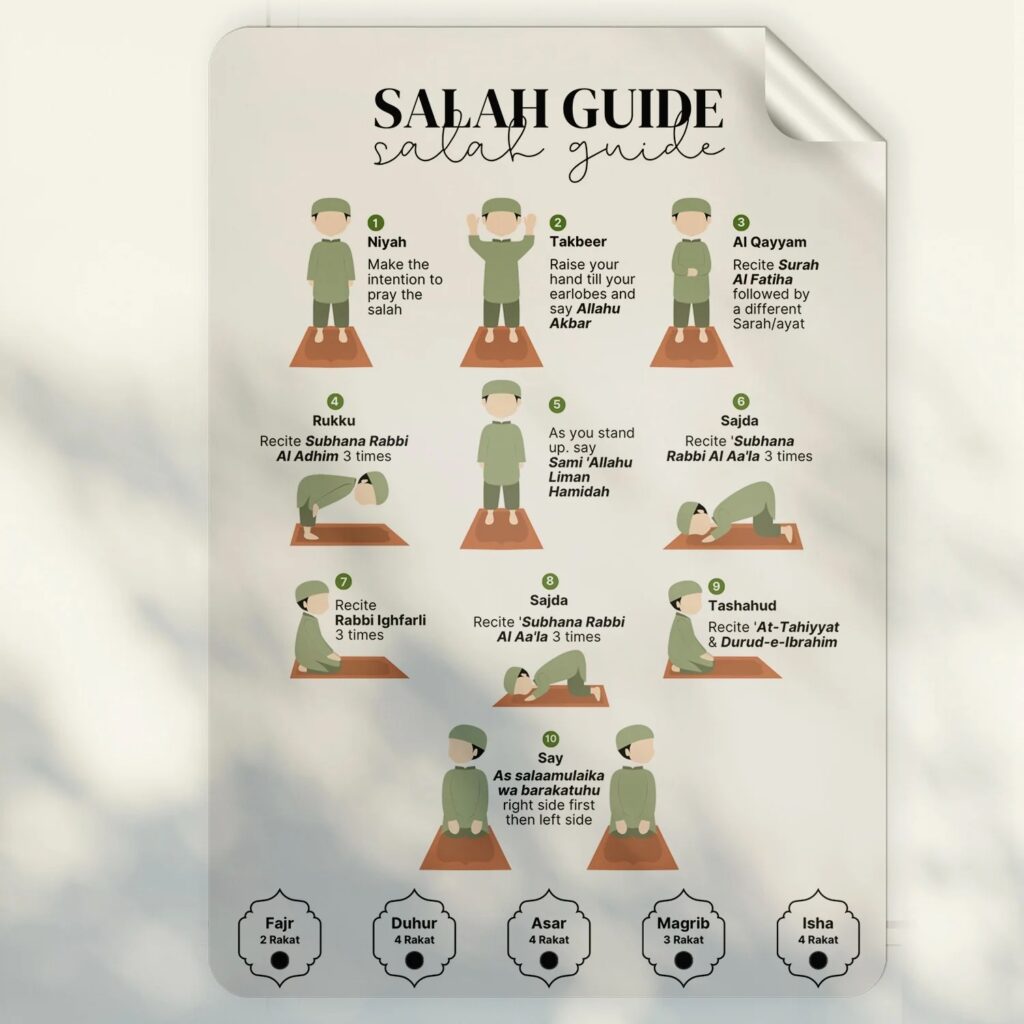
The Steps of Salah (Rak’ah by Rak’ah)
1. Takbeer al-Ihram (Opening Takbeer)
- Raise both hands to shoulder or ear level.
- Say: “Allahu Akbar” (Allah is the Greatest).
Example:
A new Muslim in London raises his hands and says “Allahu Akbar,” marking the start of his prayer.
2. Qiyam (Standing)
- Place right hand over left on the chest.
- Recite:
- Opening Supplication (e.g., “Subhanaka Allahumma wa bihamdika…”)
- Surah Al-Fatiha (the Opening Chapter)
- Another Surah or verses (e.g., Surah Al-Ikhlas)
Example:
A child recites Surah Al-Fatiha, then Surah Al-Kawthar:
“Inna a’tainaka al-kawthar…” If you’d like to go deeper, see our Faith in the six pillars of iman the foundation of tawhid ar rububiyyah.
3. Ruku (Bowing)
- Bow, keeping back straight, hands on knees.
- Say: “Subhana Rabbiyal Adheem” (Glory is to my Lord, the Most Great) three times.
Example:
A student bows, ensuring his back is flat, and repeats the phrase three times.
4. I’tidal (Standing after Ruku)
- Stand up straight.
- Say: “Sami’ Allahu liman Hamidah, Rabbana lakal hamd” (Allah hears the one who praises Him; Our Lord, to You belongs all praise).
5. Sujud (Prostration)
- Go down, touching forehead, nose, palms, knees, and toes to the ground.
- Say: “Subhana Rabbiyal A’la” (Glory is to my Lord, the Most High) three times.
Example:
A worshipper ensures all seven body parts touch the ground, as taught by the Prophet.
6. Jalsa (Sitting between Sujud)
- Sit on your legs.
- Say: “Rabbighfir li” (O Lord, forgive me).
7. Second Sujud
- Repeat the prostration.
8. Next Rak’ah
- Stand up and repeat steps 2–7 for the required number of rak’ahs.
9. Tashahhud (Testification)
- After the last rak’ah, sit and recite the testimony of faith and prayers for the Prophet.
Example:
A worshipper recites:
“At-tahiyyatu lillahi was-salawatu wat-tayyibat…”
10. Tasleem (Ending the Prayer)
- Turn head to the right and say: “Assalamu Alaikum wa Rahmatullah”
- Repeat to the left.
Example: Performing Maghrib Prayer (3 Rak’ahs)
- First Rak’ah:
- Takbeer, Qiyam (Al-Fatiha + Surah), Ruku, I’tidal, Sujud, Jalsa, Sujud, Stand up.
- Second Rak’ah:
- Qiyam (Al-Fatiha + Surah), Ruku, I’tidal, Sujud, Jalsa, Sujud, Sit for Tashahhud.
- Third Rak’ah:
- Qiyam (Al-Fatiha only), Ruku, I’tidal, Sujud, Jalsa, Sujud, Final Tashahhud, Tasleem.
Common Mistakes in Salah (and How to Avoid Them)
- Rushing through movements: Each position should be performed calmly.
- Incorrect recitation: Learn the correct pronunciation, especially for Al-Fatiha.
- Not facing Qiblah: Always check your direction.
- Improper covering: Ensure clothing meets Islamic requirements.
- Skipping Sunnah acts: While not obligatory, Sunnah actions complete the prayer.
Example:
A young boy rushes through sujud. His father gently reminds him to pause and say “Subhana Rabbiyal A’la” three times.
Benefits of Salah (with Real-Life Examples)
1. Spiritual Connection
Salah is a direct conversation with Allah.
Example: After a stressful day, a mother finds peace in her Isha prayer.
2. Forgiveness of Sins
Each prayer wipes away minor sins.
Example: The Prophet likened Salah to bathing in a river five times a day.
3. Discipline and Time Management
Praying on time structures your day.
Example: A student schedules study breaks around Salah times, boosting productivity.
4. Community and Unity
Praying in congregation builds brotherhood.
Example: Friday prayers bring together Muslims from all walks of life.
5. Physical and Mental Health
Movements improve flexibility and focus.
Example: Elderly worshippers maintain mobility through regular Salah.
How Muslim Academy Helps You Master Salah
1. Live, Interactive Classes
- One-on-one or group sessions with certified teachers.
- Personalized feedback on your recitation and movements.
2. Step-by-Step Video Tutorials
- Visual guides for each step of Salah.
- Example: Watch a teacher demonstrate proper sujud and compare your own.
3. Correction of Common Mistakes
- Teachers spot and correct errors in real-time.
- Example: If you mispronounce a word, your teacher helps you fix it immediately.
4. Flexible Scheduling
- Learn at your own pace, from anywhere in the world.
5. Progress Tracking and Certificates
- Regular assessments and progress reports.
- Earn certificates as you master each level.
6. Family and Kids Programs
- Special courses for children and families.
- Example: Interactive games and stories to help kids love Salah.
7. Community Support
- Join webinars, Q&A sessions, and a supportive learning community.
Conclusion
Salah is the foundation of a Muslim’s faith and daily life. By understanding its steps, fulfilling its conditions, and appreciating its benefits, you can transform your relationship with Allah and enrich your life. Whether you’re a beginner or want to perfect your prayer, Muslim Academy offers the resources, support, and expertise you need.
Ready to perfect your Salah?
Visit Muslim Academy and start your journey today!
https://www.youtube.com/shorts/ksmz9-7s8JQ?feature=share
The Five Pillars of Islam: Foundations of Faith & Spiritual Growth
This pairs well with our How to teach kids Islam.