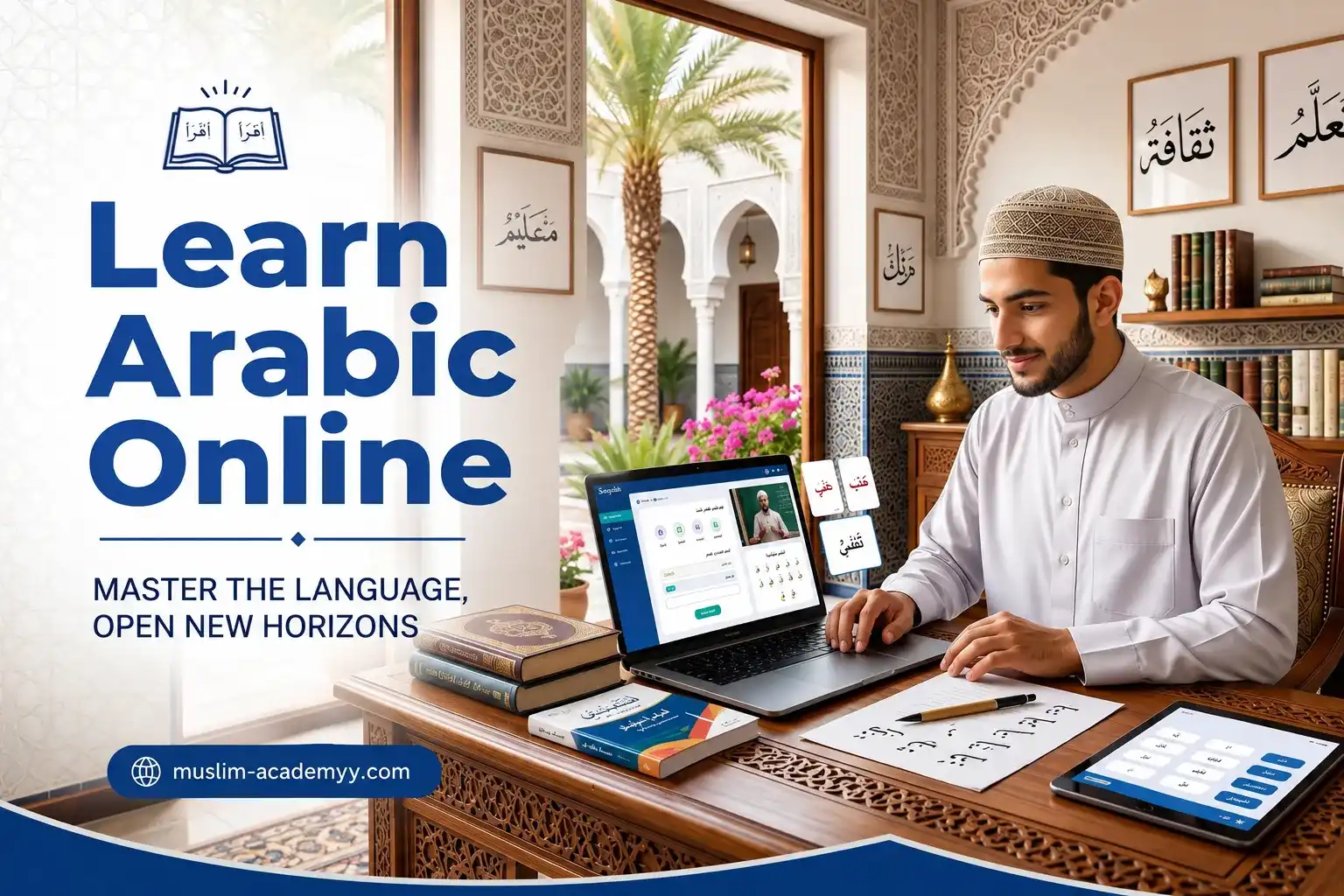
Online Arabic Course – Learn the Language of the Qur’an

Discover the depth and precision of Arabic through Muslim Academy’s Arabic Online Course — built specifically for Muslims who want to understand the Qur’an and Sunnah directly, not just hold a casual conversation. Our goal is simple: to help you connect with the words Allah revealed in the language they were revealed in. For a deeper dive, take a look at our Seerah course online.

Most general Arabic courses teach the language a tourist would need. This one is different — every lesson is chosen because it moves you closer to reading Qur’an and Hadith with real comprehension, not just reciting sounds you don’t fully understand. For learners who want to go further, take a look at our online Arabic academy for adults.

Why Learning Arabic Changes Your Relationship with the Qur’an?

Why Learning Arabic Changes Your Relationship with the Qur'an?
Why Learning Arabic Changes Your Relationship with the Qur’an?

There’s a particular moment a lot of students describe: the first time they read an ayah they’ve recited for years and suddenly understand it directly, without a translator’s word choices standing between them and the meaning. Translations are useful, but they’re always someone else’s interpretation of the original words. Arabic removes that layer entirely. If this is an area you’d like to explore in more depth, check out our Arabic classes for beginners.

Beyond the Qur’an itself, Arabic unlocks the classical books of tafsir, hadith commentary, and fiqh that were never fully translatable — a lot of nuance simply doesn’t survive translation. Students who reach even an intermediate level start noticing things in the text that translations flatten out or miss entirely.

How the Course Is Structured?

Arabic is a big subject, so the course moves through clear stages rather than throwing grammar and vocabulary at students all at once.

Stage 1 — Alphabet, Sounds, and Reading

Students who are completely new to Arabic start with the alphabet, the correct pronunciation of each letter, and basic reading fluency — the foundation on which everything else depends on.

Stage 2 — Core Grammar (Nahw & Sarf)

This stage covers sentence structure, verb conjugation, and word patterns — the grammar that turns “recognizing words” into “actually parsing a sentence.” This is usually where students start feeling real momentum.

Stage 3 — Qur’anic and Classical Arabic

Once grammar is solid, lessons shift toward vocabulary and expressions drawn directly from the Qur’an and Sunnah, along with practice reading real ayat and hadith rather than textbook sentences.

What Will You Learn?

  • Reading and writing Arabic fluently, starting from the alphabet if needed
  • Arabic grammar (Nahw & Sarf) explained clearly, without unnecessary jargon
  • Vocabulary built directly from the Qur’an and Sunnah, not generic word lists
  • Listening and conversation skills, developed alongside the classical material
  • The ability to read and start understanding Qur’anic and classical Arabic texts directly

A Question Almost Every New Student Asks

“How long until I can actually understand the Qur’an without a translation?” There’s no single honest answer — it depends on your starting point, how many sessions you take per week, and how much time you put in outside class.

What we can say is that most consistent students start recognizing words and simple phrases within a few months, and reach a level where they can follow the general meaning of straightforward ayat within a year or two of steady study. Full mastery of classical Arabic takes considerably longer, the same as it would for any serious language, but meaningful, motivating progress happens much sooner than most people expect.

Mistakes Self-Taught Students Usually Run Into

A lot of motivated students try to learn Qur’anic Arabic on their own first, using apps or YouTube channels, before eventually looking for a real teacher — and the pattern of what goes wrong is fairly consistent. The most common issue is learning vocabulary without grammar, which lets someone recognize individual words in an ayah without being able to actually parse how they fit together, so comprehension stalls at “I know what some of these words mean” rather than progressing to “I understand this sentence.”

The second common issue is skipping Sarf (word patterns/morphology) entirely, which makes the dictionary nearly useless later on — Arabic dictionaries are organized by root letters, and without understanding word patterns, looking up an unfamiliar word becomes guesswork. A structured course fixes both problems early, before they turn into habits that are harder to unlearn than to learn the first time correctly.

What Makes Qur’anic Arabic Different from Everyday Spoken Arabic?

What Makes Qur'anic Arabic Different from Everyday Spoken Arabic?
What Makes Qur’anic Arabic Different from Everyday Spoken Arabic?

Students are sometimes surprised to learn that the Arabic spoken in Cairo, Riyadh, or Casablanca today differs quite a bit from Classical Arabic — modern spoken dialects have their own grammar shortcuts, slang, and pronunciation shifts that don’t apply to the Qur’an at all. This course focuses specifically on Modern Standard and Classical Arabic — the register used in the Qur’an, Hadith, and formal writing — rather than any regional dialect, since that’s the form of the language that actually unlocks Islamic texts.

Who Should Enroll?

  • Muslims who want to understand the Qur’an and Hadith directly, without relying solely on translation
  • Complete beginners with zero prior Arabic knowledge
  • Students preparing for deeper Islamic studies that require Arabic literacy
  • Adults and children seeking an Islamically-grounded Arabic curriculum rather than a secular one

How Classes Work?

Classes are live and one-on-one (or small group, if preferred), taught by native Arabic-speaking instructors experienced specifically with non-native, Islamically-motivated students. Sessions are scheduled around your timezone, and teachers track exactly which grammar points and vocabulary you’ve covered, revisiting anything shaky before adding new material rather than moving on regardless.

Why Learn Arabic with Muslim Academy?

General Arabic courses — including many popular apps — are built for tourism or business Arabic, which means huge portions of what they teach are irrelevant to a student whose real goal is the Qur’an. Our curriculum skips that detour entirely. Every grammar point and vocabulary set is chosen because it shows up in the Qur’an, Hadith, or classical Islamic texts, so the hours you put in translate directly into the goal that actually matters to you.

Teachers are also native speakers who’ve specifically taught non-native, Islamically-motivated adult learners before — which matters more than it sounds. Someone who only teaches children, or only teaches conversational Arabic to tourists, often struggles to explain grammar the way an adult beginner needs it explained. Our instructors are used to answering the kind of grammar questions that come up specifically when someone is trying to parse a Qur’anic ayah, not just order food in a restaurant.

Frequently Asked Questions About the Arabic Online Course

Do I need to already know how to read Arabic script?

No. Complete beginners start with the alphabet and reading fluency before moving into grammar — there’s no assumed prior knowledge.

Is this course only for adults, or can children join too?

Both. Children typically move a bit slower through the grammar-heavy stages and spend more time on reading and vocabulary, while adults often move faster through grammar since they can grasp abstract rules more quickly.

Will this help me read classical tafsir and hadith books, not just the Qur’an?

Yes, that’s specifically what Stage 3 is built for — moving from basic Qur’anic vocabulary into the kind of classical Arabic used in tafsir and hadith commentary.

How is this different from a general Arabic app or course?

General courses teach vocabulary for daily life, travel, and business. This course is built entirely around Qur’anic and classical vocabulary and grammar, so almost everything you learn applies directly to reading Islamic texts.

Do you offer a certificate after completing the course?

Yes, students receive a certificate of completion after finishing each stage of the program.

Will I learn spoken Egyptian, Gulf, or Levantine Arabic in this course?

No — this course focuses on Modern Standard and Classical Arabic, the form used in the Qur’an, Hadith, and formal writing, rather than any regional spoken dialect. Students who also want a specific dialect for travel or family reasons usually pursue that separately.

I tried learning Arabic before and gave up — how is this different?

Most people who give up were taught vocabulary without grammar, so they never developed the ability to actually parse a sentence. This course builds grammar and vocabulary together from the start, which is usually the missing piece that makes the difference this time.

How many sessions per week do most students take?

It varies, but most students who make steady progress take two to three sessions a week. Fewer sessions still work, just at a slower pace — teachers can help you find a schedule that’s sustainable for your routine, then adjust the pace up or down as your availability changes.

Progress also compounds in a way that surprises a lot of students — once the core grammar clicks, reading new ayat gets noticeably easier each month, because so much of Qur’anic Arabic reuses the same root system and sentence patterns across different surahs.

Connect Your Heart with the Qur’an

Connect Your Heart with the Qur'an
Connect Your Heart with the Qur’an

Arabic is the key to truly understanding Islam. Join thousands of Muslims learning Arabic online with Muslim Academy and begin your journey toward understanding the Qur’an in its original language.

Learn Arabic. Understand the Qur’an. Live the Message.

Related courses: Fiqh Course · Online Tajweed Course · Online Hifz Program · All Courses

Join Us Today:

Email: info@muslim-academyy.com

WhatsApp: +201022713803