
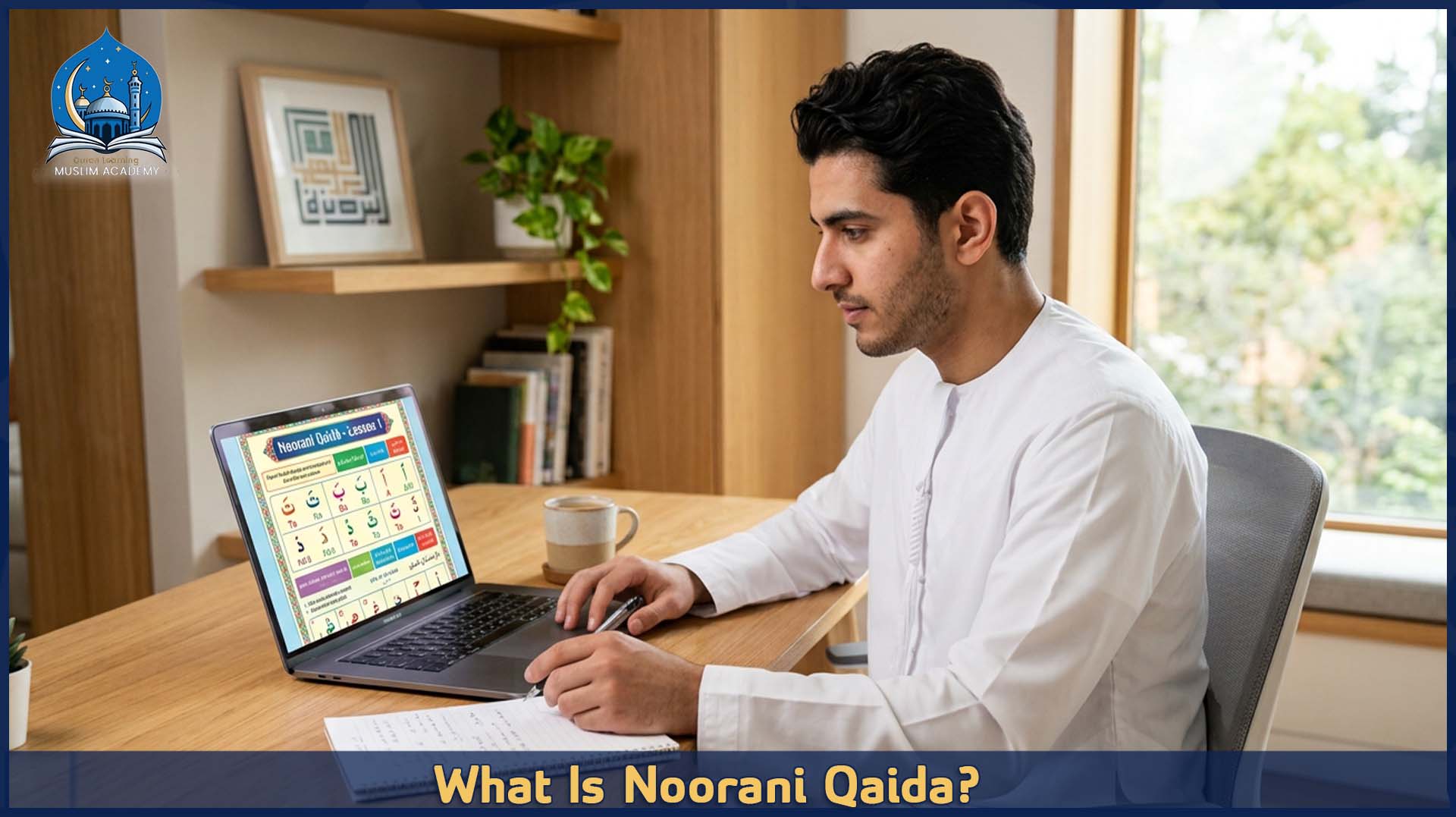
What Is Noorani Qaida? A Complete Guide for Beginners
What Noorani Qaida is is one of the most common questions asked by beginners who want to start their journey of learning Quran recitation correctly. Understanding what Noorani Qaida is helps new learners discover the importance of this basic Quran learning method and how it builds strong reading skills from the beginning.
Noorani Qaida is a structured educational system designed to teach Arabic letters, correct pronunciation, and the essential rules required for accurate Quran reading. When learners ask what Noorani Qaida is, the answer is that it is a beginner-friendly guide that takes students step by step from recognizing Arabic letters to reading Quranic words with confidence.
For many Muslims, learning to read the Quran can feel challenging, especially for those who are not familiar with Arabic letters or pronunciation rules. This is where Noorani Qaida becomes valuable. By learning what Noorani Qaida is and following its lessons, students can understand the foundation of Quran recitation before moving directly to Quran verses.
The importance of Noorani Qaida comes from its ability to create a strong base for Quran learning. A student who learns letter sounds, articulation points, and basic Tajweed rules correctly will have a much easier time reading the Quran fluently. Therefore, what is Noorani Qaida is not only a question about a book but also about a complete learning approach that prepares students for lifelong Quran study.
This method is suitable for children, adults, and beginners from different backgrounds. Many students today choose online Quran programs such as Muslim Online Quran Academy, where qualified teachers explain what is noorani qaida and guide learners through every lesson step by step.
What is Noorani Qaida and how does it help beginners read the Quran?
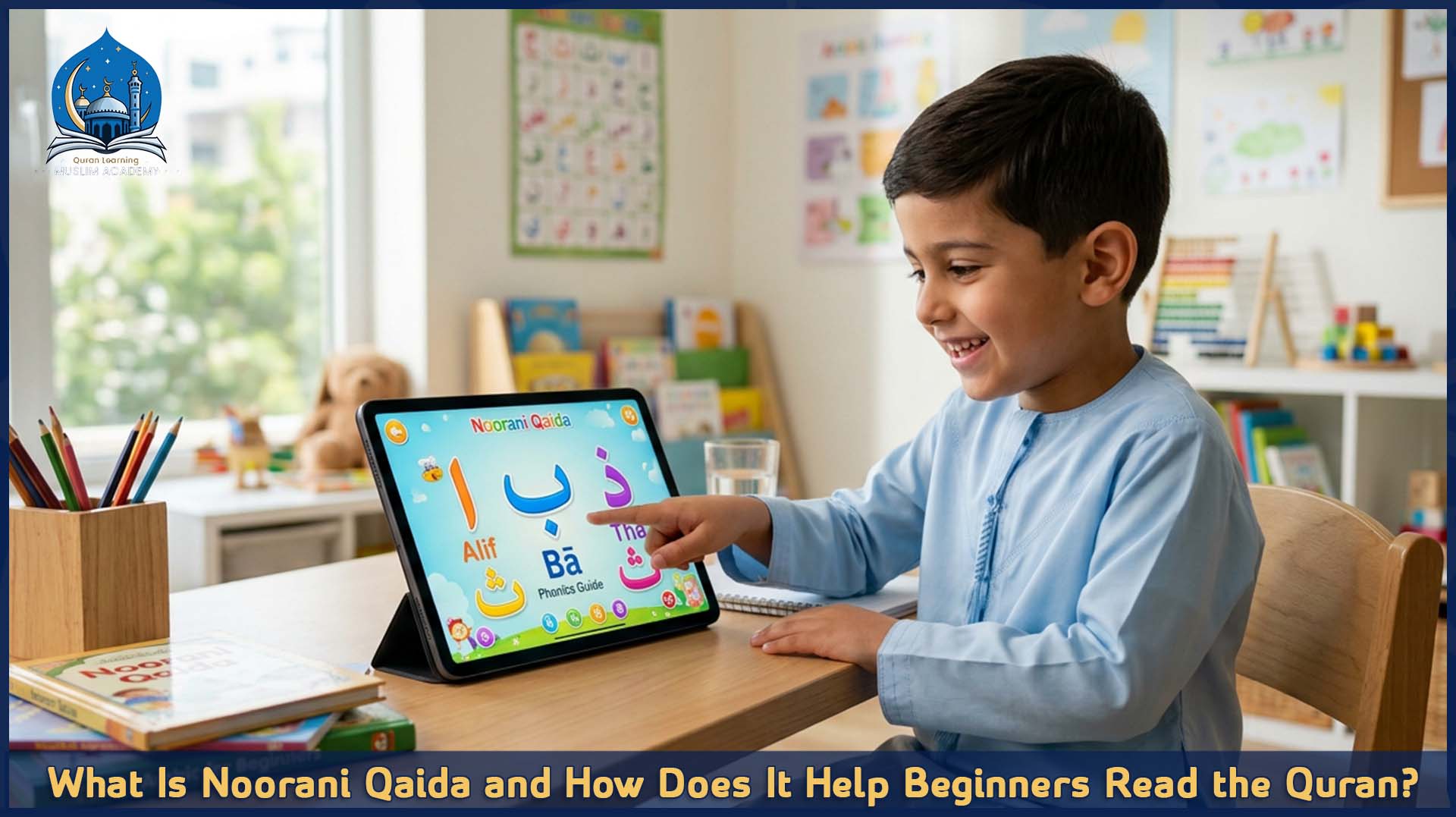
To understand what Noorani Qaida is, it is important to know that it is more than a simple collection of Arabic letters. Noorani Qaida is a complete learning system that trains students to recognize letters, pronounce them correctly, and combine them to read Arabic words.
When beginners ask what Noorani Qaida is, they usually want to know how this method helps them start Quran reading. The answer is that Noorani Qaida creates a gradual learning process where students master small skills before moving to more advanced levels.
The method begins with learning the Arabic alphabet. Students study every letter individually, learn its shape, and practice its correct pronunciation. This step is essential because incorrect pronunciation at the beginning can affect Quran recitation later.
After learning separate letters, students practice connected letters and simple combinations. They understand how Arabic letters change their forms when they appear at the beginning, middle, or end of words.
Another important part of understanding what Noorani Qaida is is learning Arabic vowel signs, known as Harakat. These movements help learners pronounce words correctly.
The main short vowels include:
- Fatha (َ)
- Kasra (ِ)
- Damma (ُ)
Learning these signs allows students to read Arabic words accurately and prepares them for Quran recitation. The organized structure of Noorani Qaida makes it effective for beginners because it avoids complicated lessons at the start. Instead, learners progress gradually and gain confidence with every stage.
Start learning Quran recitation with Tajweed today
If you want to master Quran Recitation with Tajweed and improve your pronunciation with confidence, this is the perfect time to start. Muslim Academy offers structured online lessons that help you learn step by step with qualified teachers and clear guidance.
In addition, you will practice regularly, receive real corrections, and build strong Quran reading skills from the comfort of your home. Therefore, don’t wait and take action today to improve your recitation, strengthen your understanding, and connect deeply with the Holy Quran through professional and flexible learning.

The origin and development of Noorani Qaida
Many people who search for Noorani Qaida also want to know about its background and development. Noorani Qaida was created as an educational approach to simplify Quran reading for beginners and make Arabic pronunciation easier to understand.
The method became popular because of its clear sequence and focus on accuracy. It teaches learners the Arabic alphabet, pronunciation rules, articulation points, and basic Tajweed concepts before they begin reading complete Quran chapters.
Over time, Noorani Qaida became widely used in Quran schools and Islamic learning centers around the world. Thousands of children and adults have started their Quran journey through this method.
Today, technology has made Noorani Qaida lessons more accessible. Students can learn online with qualified teachers who explain what Noorani Qaida is and provide personalized guidance based on each learner’s level.
Online Quran academies such as Muslim Online Quran Academy use structured courses to help students understand Noorani Qaida from their homes while receiving professional instruction.
How the lessons are structured
When learners search for Noorani Qaida, they often want to understand its lessons and how the course is organized. Noorani Qaida follows a clear structure that helps beginners develop Quran reading skills simply and effectively.
The main purpose of this structure is to move students gradually from basic Arabic recognition to proper Quran recitation. Understanding Noorani Qaida means knowing that every lesson has a specific goal designed to improve reading accuracy.
The main stages of Noorani Qaida include:
Learning Arabic letters
The first stage in learning Noorani Qaida focuses on recognizing Arabic letters and learning their correct sounds. Students practice each letter separately and understand how every letter is pronounced.
For beginners asking what Noorani Qaida teaches, this stage explains why letter recognition is the foundation of Quran reading. If learners do not master Arabic letters correctly, they may struggle with Quran pronunciation later. Students practice distinguishing between letters that may appear or sound similar, such as:
- س and ص
- ت and ط
- د and ض
- ح and ه
This practice helps learners improve their pronunciation and avoid common mistakes during Quran recitation.
Understanding letter combinations
Another important part of learning Noorani Qaida is understanding how Arabic letters connect with each other. Arabic writing changes depending on the position of the letter in a word. Noorani Qaida teaches students how letters appear when they are joined together and how their sounds remain connected. This lesson prepares beginners to read complete Arabic words and Quranic phrases more easily.
Learning Harakat and vowel signs
Anyone who wants to know what Noorani Qaida is should understand the importance of Harakat. These vowel signs control the pronunciation of Arabic letters and help learners read correctly. Noorani Qaida introduces students to:
- Fatha (َ)
- Kasra (ِ)
- Damma (ُ)
Through continuous practice, learners understand how changing a vowel sign changes the sound of a letter. This knowledge becomes essential when students begin reading Quran verses because accurate pronunciation depends on understanding these movements.
Learning Sukoon and Shaddah
A complete explanation of Noorani Qaida should include Sukoon and Shaddah because these rules are necessary for correct Quran recitation. Sukoon teaches students how to pronounce a letter without a vowel sound, while Shaddah teaches them how to pronounce doubled letters properly. These lessons help learners recognize Quranic words more accurately and prepare them for advanced Tajweed rules.
Introduction to Madd and basic Tajweed
Another answer to the question what Noorani Qaida teaches is that it introduces beginners to the basic principles of Tajweed. Students learn simple elongation rules, including how long sounds should be stretched during Quran recitation. This early introduction makes future Tajweed learning easier. Noorani Qaida does not replace advanced Tajweed courses, but it creates the foundation students need before studying detailed pronunciation rules.
Why is Noorani Qaida the first step in Quran education?
Many beginners wonder what Noorani Qaida is and why they should study it before reading the Quran directly. The reason is that Quran reading requires strong pronunciation skills and a clear understanding of learn arabic online letters. Starting Quran reading without proper preparation may lead to pronunciation mistakes. Noorani Qaida prevents this by teaching learners the necessary basics first.
Correct pronunciation of Arabic letters
One of the most important benefits of Noorani Qaida is improving letter pronunciation. Arabic contains sounds that may not exist in other languages, so beginners need proper guidance. When students understand what Noorani Qaida is, they realize that this method focuses on the correct pronunciation of every Arabic letter from the beginning.
Building reading confidence
Many students feel nervous when they start learning Quran. Noorani Qaida helps remove this difficulty by dividing learning into small and manageable steps. Each successful lesson increases confidence and motivates learners to continue their Quran journey.
Preparing students for Tajweed
Tajweed requires knowledge of pronunciation rules, letter characteristics, and articulation points. Noorani Qaida provides the basic preparation needed for future Tajweed studies. Students who complete Noorani Qaida usually find it easier to understand advanced Quran recitation techniques.
Reducing Quran reading mistakes
A major reason students study Noorani Qaida is to avoid mistakes while reading Quran. By learning letters, sounds, and basic rules correctly, students develop better accuracy and fluency. For learners searching for professional guidance about what Noorani Qaida is, online Quran programs such as Muslim Online Quran Academy provide structured lessons with qualified instructors who help children and adults progress effectively.
What are the benefits of Noorani Qaida for children and adults?
Understanding what Noorani Qaida is also requires knowing why this method is suitable for different age groups. Noorani Qaida is not limited to young children; it is also an effective starting point for adults who want to improve their Quran reading skills.
Many people ask what Noorani Qaida is because they want to find an easy way to begin learning Quran. The answer is that Noorani Qaida provides a simple and organized approach that allows learners to build their knowledge step by step.
Benefits of Noorani Qaida for children
Children can benefit greatly from Noorani Qaida because it provides a simple and engaging way to begin their Quran learning journey. Rather than expecting quran for children’s to memorize Quran verses from the beginning, this method focuses first on teaching the essential reading skills they need, such as recognizing Arabic letters, improving pronunciation, and building confidence in Quran recitation. The main benefits include:
- Learning Arabic letters correctly
- Improving Quran pronunciation
- Developing confidence in reading
- Preparing for Quran memorization
- Understanding basic Tajweed concepts
- Creating a strong connection with Quran learning
Parents who understand what Noorani Qaida is can recognize why it is considered one of the best first steps for children who are beginning their Quran journey. A qualified Quran teacher can make Noorani Qaida lessons interactive by using simple explanations, repetition, and practical exercises that match the child’s learning speed.
Benefits of Noorani Qaida for adults
Adults can also benefit from learning Noorani Qaida, even if they have never studied Arabic before. Many adults search for Noorani Qaida because they want to correct their Quran reading or start learning from the beginning. Noorani Qaida helps online quran lessons for adults improve:
- Arabic letter recognition
- Pronunciation accuracy
- Quran reading fluency
- Basic Tajweed understanding
- Confidence while reciting Quran
Online learning options have made it easier for adults to study Noorani Qaida according to their schedules. Platforms like Muslim Online Quran Academy provide flexible lessons where teachers explain what Noorani Qaida is and guide students through every level.
How Noorani Qaida improves Quran recitation
After understanding the basics of Noorani Qaida, the next step is to see how this method affects actual Quran recitation. The purpose is not simply to recognize Arabic letters. Instead, learners gradually develop the ability to pronounce those letters correctly and use them naturally while reading Quranic words.
A common problem among beginners is that they may recognize a word visually but struggle to pronounce it accurately. Noorani Qaida addresses this problem through repetition and progressive exercises. The learner first practices individual sounds, then combinations, and eventually more complex forms.
This gradual progression is particularly useful for students who have never studied Arabic. They do not have to memorize complicated terminology before developing basic reading skills. Instead, they learn through practical examples and repeated correction.
A teacher can also identify pronunciation problems early. For example, a student may confuse two Arabic letters because their sounds are similar. Regular practice allows the teacher to correct the mistake before it becomes a permanent habit. For this reason, Noorani Qaida is often used before beginning systematic Quran reading or memorization.
Basic reading skills covered in the lessons
The aspects of Noorani Qaida becomes clearer when we examine the skills students develop during the course. Although the exact organization may vary between editions, the learning process generally moves from basic letters to increasingly complex reading patterns.
1. Arabic alphabet recognition
Students begin by learning the Arabic Alphabet for Beginners. At this stage, the goal is to recognize each letter and distinguish it from other letters. This may seem simple, but accurate letter recognition is extremely important. Arabic contains several letters that can appear similar to beginners, particularly when they are connected in words.
2. Correct articulation points
Students learn where different Arabic sounds originate. These articulation points are commonly known as Makharij al-Huruf. Understanding articulation points helps learners produce sounds more accurately instead of relying on approximations from their native language.
3. Letter characteristics
Arabic letters also have specific characteristics that influence their pronunciation. A good learning program introduces these characteristics gradually so students can develop better control over their recitation.
4. Short vowels
Fatha, Kasra, and Damma are introduced as essential pronunciation signs. For example, the same Arabic letter can produce different sounds depending on the movement attached to it. Students practice these combinations repeatedly until they become familiar.
5. Sukoon
Sukoon indicates that letter does not carry a short vowel. Learning how to pronounce letters with Sukoon is an important stage because it prepares students for more complicated Quranic words.
6. Shaddah
Shaddah indicates a doubled consonant sound. Students learn how to recognize it and pronounce the letter correctly without skipping or weakening the required sound.
7. Tanween
Students are introduced to the basic forms of Tanween and learn how they affect pronunciation.
8. Madd
Madd introduces students to elongated sounds. This stage is important because Quranic recitation requires appropriate control of sound duration.
9. Practical reading
Finally, students apply the skills they have learned to increasingly complex combinations and Quranic expressions. This is where the lessons begin connecting basic reading skills with actual Quran recitation.
Main components of Noorani Qaida
A successful Noorani Qaida course should not focus on one skill alone. Instead, it combines several elements that work together to develop accurate reading. The main components include:
- Arabic letters: The learner develops familiarity with the alphabet and its different written forms.
- Makharij: Students learn the articulation points needed to pronounce letters accurately.
- Harakat: Short vowels teach students how to read letters with different sounds.
- Sukoon: Learners practice consonant sounds and understand how silent letters are pronounced.
- Shaddah: Students learn how doubled letters affect pronunciation.
- Tanween: This introduces additional vowel sounds commonly found in Arabic and Quranic reading.
- Madd: Learners begin understanding elongation and the importance of maintaining appropriate sound duration.
- Practical exercises: Repetition helps transfer knowledge from theory into actual reading.
The combination of these elements gives students a structured path instead of asking them to learn Quran reading randomly
How basic reading supports later Tajweed study
One of the most important aspects of Noorani Qaida is that it serves as a foundation for later Tajweed study. Tajweed is the discipline concerned with reciting the Quran according to established pronunciation and recitation principles. Students who begin advanced Tajweed without strong basic reading skills may struggle because they are trying to learn quran online with Tajweed rules while still struggling with individual letters. Noorani Qaida helps separate the learning process into manageable stages.
First, the learner becomes comfortable with letters and their sounds. Then, the student develops familiarity with movements and common pronunciation patterns. After that, the learner can study more detailed Tajweed rules with greater confidence. Depending on the curriculum, students may eventually encounter rules related to:
- Ghunnah
- Qalqalah
- Ikhfa
- Idgham
- Iqlab
- Izhar
- Madd
- Rules of Meem Sakinah
- Rules of Noon Sakinah and Tanween
The important point is that Noorani Qaida is not necessarily a replacement for a complete Tajweed course. Rather, it gives beginners the preparation they need before studying Tajweed at a deeper level.
How to teach Noorani Qaida effectively
Teaching Noorani Qaida requires more than asking students to repeat pages. The teacher should understand the learner’s level and identify the areas that require the most attention. An effective lesson can follow a simple sequence.
Start with assessment
Before beginning, the teacher should determine whether the student already recognizes Arabic letters. A child who knows the alphabet does not need the same starting point as an adult who has never studied Arabic.
Introduce one concept at a time
Students should not receive too many new concepts during one lesson. For example, a teacher may focus on letter pronunciation first and introduce new vowel patterns only after the learner demonstrates reasonable confidence.
Use repetition
Repetition is central to Quran reading education. Students need opportunities to hear a correct pronunciation, repeat it, receive correction, and try again.
Correct errors immediately
Small pronunciation errors can become habits if they are ignored. Teachers should therefore provide clear and respectful correction throughout the lesson.
Connect lessons with previous knowledge
Each new lesson should build on what the student already knows. This makes the learning process more logical and reduces confusion.
Practice between lessons
Students should practice regularly outside the class. Even a short daily practice session can reinforce what was learned during the lesson. An online program such as Muslim Online Quran Academy can make this process convenient because students can receive individualized instruction without traveling to a physical classroom.
Practising letter pronunciation
Pronunciation practice matters from the first lessons. If an Arabic sound is unfamiliar, listen to the teacher, repeat it slowly, and compare it with similar sounds. Ask for correction before combining the letter with vowels and longer words.
For example, a beginner may find it difficult to distinguish between certain emphatic and non-emphatic letters. Others may struggle with letters produced from the throat or with sounds involving the tongue. A teacher can address these difficulties through:
- Listening exercises.
- Slow pronunciation.
- Repetition.
- Individual correction.
- Comparison between similar letters.
- Practice in different word positions.
The learner should practice a letter separately before using it in increasingly complex combinations. This approach is particularly helpful for children because they can develop correct pronunciation habits before they begin reading longer Quranic passages.
How Noorani Qaida helps with Makharij al-Huruf?
Makharij al-Huruf refers to the articulation points of Arabic letters. Correctly understanding these points is an important part of Quran recitation. A student may know that two letters are different but still pronounce them almost identically. This can affect the accuracy and clarity of recitation.
Noorani Qaida gives students repeated exposure to individual letters and their sounds. Under the supervision of a qualified teacher, learners can identify their pronunciation weaknesses and work on them gradually.
For example, letters produced from different areas of the mouth, tongue, or throat require different positions. The learner needs practical guidance to understand these differences. This is one reason learning with a teacher is valuable. Written explanations alone cannot always show a student exactly how a sound should be produced.
Noorani Qaida for non-Arabic speakers
Non-Arabic speakers can benefit significantly from Noorani Qaida because the method does not assume that learner already understands Arabic pronunciation. A student may know the English alphabet perfectly but still have no experience with Arabic letters. Starting directly with Quran verses can therefore create unnecessary difficulty.
Noorani Qaida provides a bridge between complete unfamiliarity with Arabic and the ability to read Quranic text. The student gradually learns:
- How Arabic letters look.
- How letters sound.
- How letters connect.
- How movements change pronunciation.
- How words are formed.
- How basic recitation rules work.
This makes it suitable for Muslims from many linguistic backgrounds. Online learning has also made these lessons more accessible. Students living in countries where Arabic-speaking Quran teachers are not readily available can study with instructors remotely through Muslim Online Quran Academy.
Noorani Qaida for Quran memorization
Strong reading skills can also support Quran memorization. When a student memorizes Quran without being able to read accurately, mistakes can become associated with memorized passages. Correcting those mistakes later may require additional effort.
Learning Noorani Qaida before or alongside memorization helps students develop better reading habits. A student preparing for Hifz can benefit from:
- Better pronunciation.
- Stronger letter recognition.
- Improved reading fluency.
- Greater confidence when reviewing memorized passages.
- Better awareness of basic Tajweed principles.
However, memorization and Noorani Qaida are different learning goals. Noorani Qaida focuses primarily on foundational reading skills, while Hifz focuses on retaining Quranic verses accurately. For this reason, students should receive an appropriate plan based on their current level.
What is the best age to start Noorani Qaida?
There is no single age that applies to every learner. Children can begin when they have enough attention and readiness to participate in short lessons. Some children begin at an early age, while others need more time.
Adults can start at any stage of life as well. There is no reason to feel embarrassed about beginning from the alphabet. In fact, starting from the basics can be more effective than attempting to correct years of inaccurate reading habits without understanding their source.
For children, lessons should generally be short, engaging, and interactive. For adults, teachers can often move more quickly when the learner demonstrates strong concentration and previous language experience. The most important factor is not age. It is consistency.
Noorani Qaida versus starting directly with Quran reading
Someone may wonder why they should study Noorani Qaida instead of simply opening the Quran and learning through repetition. Direct Quran reading can certainly provide valuable practice, but complete beginners may encounter several problems. They may not know:
- How to pronounce unfamiliar letters.
- Why a letter has a particular vowel.
- How Shaddah changes pronunciation.
- How Sukoon should be handled.
- When a sound should be extended.
- How to distinguish similar Arabic letters.
Noorani Qaida addresses these skills before the learner is expected to handle longer Quranic passages. Therefore, it is better viewed as preparation rather than a competing method. Once the student gains a foundation, Quran reading becomes easier and more productive.
Creating an effective Noorani Qaida learning plan

A successful learning plan should match the student’s ability rather than forcing every learner to follow the same pace. A beginner may need several lessons to become comfortable with Arabic letters. Another student who already knows Arabic may progress much faster. A practical plan can include:
- Stage 1: Arabic alphabet recognition.
- Stage 2: Letter pronunciation and articulation.
- Stage 3: Individual letters with Harakat.
- Stage 4: Connected letters and simple combinations.
- Stage 5: Sukoon and Shaddah.
- Stage 6: Tanween and Madd.
- Stage 7: More advanced combinations.
- Stage 8: Application to Quranic words and short passages.
- Stage 9: Transition toward systematic Tajweed.
The teacher can review earlier lessons regularly instead of moving forward without checking retention. This approach makes learning more stable and reduces the possibility of forgetting previously learned material.
Common mistakes beginners make while learning Noorani Qaida
Students often make predictable mistakes during the early stages. Identifying them can make the learning process easier.
Rushing through the lessons
Finishing the book quickly does not necessarily mean the student has mastered it. Accuracy should come before speed.
Ignoring pronunciation
Recognizing letters visually is not enough. Quran reading requires accurate pronunciation.
Practicing only during class
A weekly lesson without regular practice may not produce consistent progress. Short daily practice is often more effective.
Moving to Quran reading too early
Students should have a reasonable command of the foundations before attempting difficult Quranic passages independently.
Feeling embarrassed about mistakes
Mistakes are a normal part of learning. A supportive teacher should correct them without making the learner feel discouraged.
Focusing only on memorization
Memorizing a page does not automatically mean the learner understands how to pronounce every word correctly. A balanced approach combines reading, listening, repetition, correction, and gradual memorization.
The role of an online teacher in Noorani Qaida learning
Online Quran learning has changed how students access religious education. Instead of traveling to a local center, learners can attend lessons from home. A qualified online teacher can listen carefully to the student’s recitation and identify errors that may not be obvious to the learner.
This is especially important for pronunciation because a student may believe that sound is correct simply because it resembles the intended sound. An effective online lesson should include direct interaction, reading practice, correction, and feedback.
For families, online classes can also offer greater flexibility. Parents can choose lesson times that fit school, work, and family schedules. Muslim Online Quran Academy can be a suitable option for learners looking for structured online Quran education, particularly when they need individualized instruction and flexible scheduling.
Typical timeline for completing Noorani Qaida
There is no universal completion time. The duration depends on several factors:
- The learner’s age.
- Previous Arabic knowledge.
- Ability to recognize letters.
- Pronunciation difficulties.
- Number of lessons per week.
- Daily practice.
- Teacher’s assessment.
- Individual learning speed.
A student who already knows Arabic may progress quickly, while a complete beginner may need more time. More importantly, completing the pages should not be treated as the only goal. The real objective is to develop reliable reading skills that student can apply independently. A slower learner who reads accurately has achieved more than a student who finishes quickly but continues making basic mistakes.
Noorani Qaida for kids: building a strong Quran learning foundation
Understanding Noorani Qaida is important for parents who want to introduce their children to Quran learning accurately. Understanding what Noorani Qaida is helps families know why this method is considered one of the best foundations for teaching children Quran reading from an early age.
Children are among the groups that benefit most from Noorani Qaida because it introduces Quran learning in a simple, organized, and age-appropriate way. At a young age, children can develop correct pronunciation habits quickly, which makes early Quran education highly valuable.
When parents ask what Noorani Qaida teaches, they usually want to know how this method helps children start their Quran journey. Noorani Qaida teaches Arabic letters, sounds, reading patterns, and basic pronunciation rules before children begin reading complete Quran verses.
Instead of asking children to immediately memorize long Quranic passages, Noorani Qaida allows them to progress through manageable steps. They first learn individual letters, then letter combinations, vowel signs, and basic recitation skills.
Understanding what Noorani Qaida is also explains why this method creates a comfortable learning experience for children. Quran education should not feel overwhelming; it should become a positive journey that encourages curiosity, confidence, and consistency.
A good learning environment plays an important role in children’s success. Parents usually look for qualified teachers who can explain lessons patiently and use methods suitable for young learners.
Through online learning platforms such as Muslim Online Quran Academy, children can receive structured Noorani Qaida lessons designed according to their age, attention level, and learning ability.
Benefits of Noorani Qaida for young learners
When exploring Noorani Qaida, one of the most important points is understanding its benefits for children. Noorani Qaida provides several educational and practical advantages that help young learners develop strong Quran reading foundations.
Developing correct pronunciation early
One major benefit of Noorani Qaida is teaching children correct Arabic letter pronunciation from the beginning. Children who learn sounds accurately at an early age usually develop better Quran recitation skills later. Early correction prevents incorrect pronunciation habits from becoming difficult to change.
Parents who understand what Noorani Qaida is realize that pronunciation training is one of the main reasons this method is recommended for beginners.
Improving reading confidence
Many children feel uncertain when they first see Arabic text. Noorani Qaida reduces this difficulty by introducing letters and sounds gradually. As children complete each lesson, they gain confidence and become more comfortable with Quran reading. The aspects of Noorani Qaida includes understanding that this method builds confidence through continuous practice and gradual progress.
Preparing for Quran memorization
Before starting serious Quran memorization, children need strong reading skills. Noorani Qaida prepares students by helping them recognize letters, understand pronunciation, and read Arabic words correctly. A child who completes Noorani Qaida usually has a stronger foundation for future Hifz programs.
Creating regular learning habits
Learning Quran requires consistency. Noorani Qaida helps children develop a regular study routine from an early age. Daily practice teaches discipline and responsibility while creating a positive connection with Quran education.
Making Quran learning easier
One reason many parents search for Noorani Qaida is that they want an easy learning method for their children. The lessons move from simple concepts to advanced skills, allowing children to understand information without feeling overwhelmed.
How to choose the right Noorani Qaida teacher?
Understanding what Noorani Qaida is helps parents choose the right learning path for their children. A qualified teacher plays an important role in improving pronunciation, confidence, and Quran reading skills.
When asking what Noorani Qaida teaches, learners should know that right teacher does more than explain lessons. A good teacher corrects mistakes, provides guidance, and encourages regular practice.
Strong Quran recitation skills
A teacher should have accurate Quran recitation and proper pronunciation skills. Since students learn by listening and repeating, correct demonstration is essential. Understanding what Noorani Qaida is shows why pronunciation accuracy is one of the most important foundations of Quran learning.
Patience with beginners
A patient teacher helps students feel comfortable while learning new Arabic letters and sounds. This makes the learning process easier and more enjoyable. Parents searching for Noorani Qaida should choose teachers who encourage students and support their progress.
Simple explanation methods
The best teachers explain lessons in an easy way, especially for children and non-Arabic speakers. Knowing what Noorani Qaida is helps teachers organize lessons from simple steps to advanced skills.
Regular feedback and support
Continuous feedback helps students improve faster. Teachers should identify mistakes and guide learners toward better pronunciation. Students who understand what Noorani Qaida is can benefit more from regular correction and practice.
Adapting to different learning speeds
Every student learns differently. A good teacher adjusts lessons according to the learner’s ability and needs. Many families choose online Quran programs because they provide qualified instructors and flexible learning options. Platforms like Muslim Online Quran Academy help students learn Noorani Qaida with structured lessons and professional guidance. Learning Noorani Qaida with the right teacher creates a strong foundation for Quran reading, Tajweed, and future memorization.
Learning Noorani Qaida online: is it effective
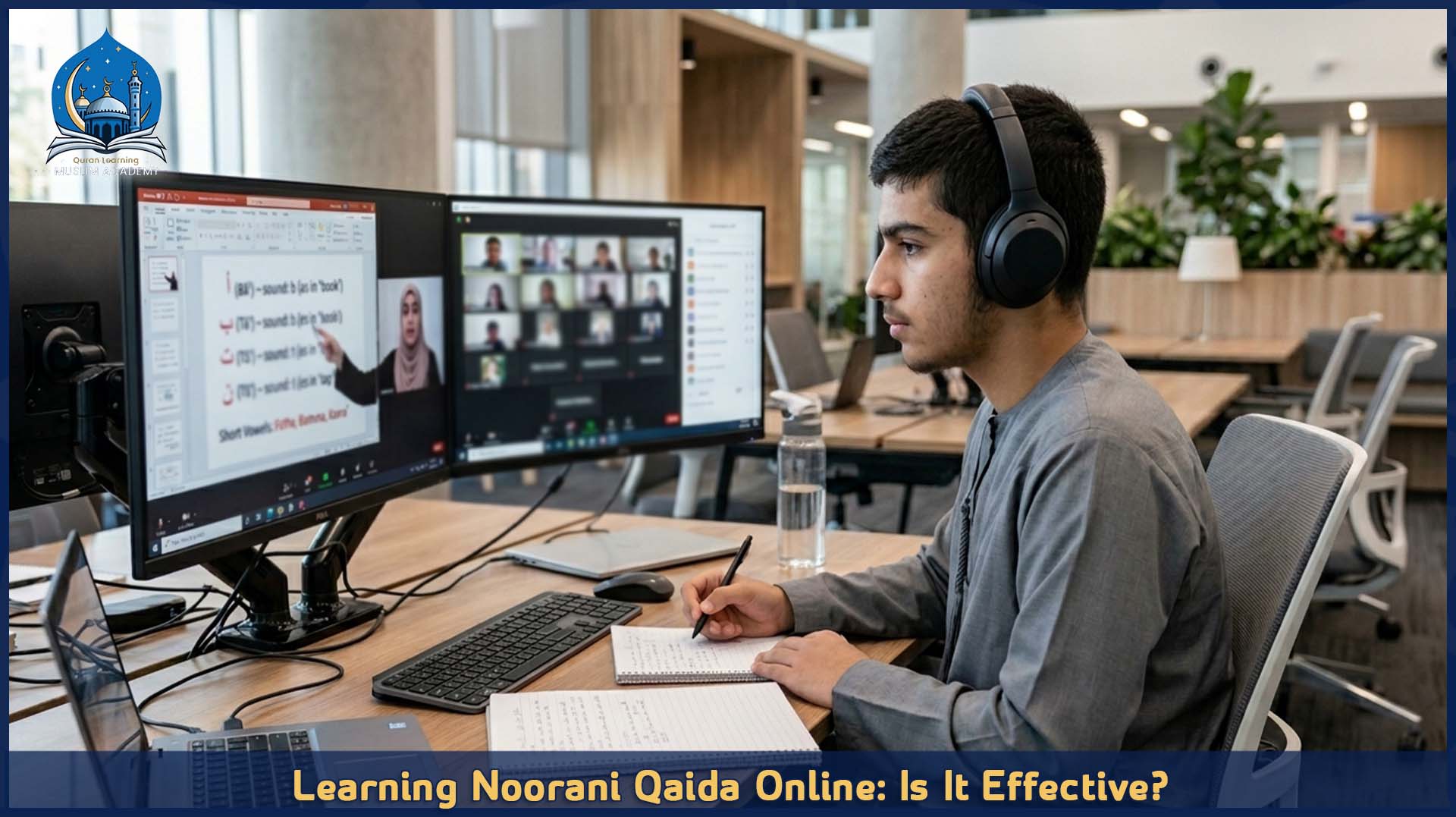
Many parents who search for Noorani Qaida also ask whether online classes can provide the same benefits as traditional learning. With modern technology, online Noorani Qaida classes have become a practical option for children and adults. When online lessons include live interaction with a qualified teacher, they can be highly effective. A successful online Noorani Qaida class usually includes:
- Live communication with the teacher.
- Reading practice.
- Pronunciation correction.
- Lesson reviews.
- Progress monitoring.
- Flexible scheduling.
The main advantage of online learning is convenience. Students can study from home without traveling to a physical classroom. This option is especially useful for families with busy schedules or learners who live in areas where experienced Quran teachers are not easily available.
However, understanding Noorani Qaida also means understanding that personal correction is essential. Recorded videos may provide information, but they cannot always identify pronunciation mistakes. Interactive lessons with a qualified teacher allow students to receive immediate guidance and improve their recitation more effectively.
Preparing for Tajweed lessons
The question of what Noorani Qaida is is closely connected with understanding the relationship between Noorani Qaida and Tajweed. Noorani Qaida prepares students with the basic skills needed before studying advanced Tajweed rules. It introduces learners to:
- Correct Arabic letter pronunciation.
- Basic sound patterns.
- Proper reading methods.
- Arabic movements.
- Common pronunciation structures.
Students who complete Noorani Qaida usually find Tajweed lessons easier because they already understand the basic principles of Arabic reading. Knowing what Noorani Qaida is helps learners recognize that it is not a replacement for complete Tajweed study, but rather the foundation that prepares them for more advanced learning.
Tajweed requires practical application, not only memorizing rules. Noorani Qaida gives students the experience of applying pronunciation skills while reading. For example, before studying detailed rules such as Noon Sakinah or Meem Sakinah, students need to understand letter sounds and basic reading patterns. Therefore, Noorani Qaida works as a bridge between learning Arabic letters and mastering Quran recitation.
Moving from Noorani Qaida to Quran reading
Completing Noorani Qaida is an important achievement, but it is only the beginning of Quran education. Students who understand what Noorani Qaida is and complete its lessons are usually ready to move toward reading directly from the Quran. The transition should happen gradually under teacher supervision. A teacher may introduce:
- Short Quranic words.
- Short verses.
- Simple Surahs.
- Regular reading exercises.
During this stage, students continue improving pronunciation and applying the skills learned in Noorani Qaida. The goal is to help students use their knowledge naturally while reading Quran instead of only remembering rules theoretically. Many learners continue their journey by studying Tajweed, Quran memorization, or Islamic studies after completing Noorani Qaida.
Common challenges while learning Noorani Qaida and their solutions
Although Noorani Qaida is designed to make Quran learning easier, beginners may face some challenges. Understanding what Noorani Qaida is also includes knowing how to overcome these difficulties.
Difficulty pronouncing certain letters
Some Arabic letters may be unfamiliar, especially for students who do not speak Arabic. The solution is regular practice with teacher guidance until pronunciation becomes natural.
Losing motivation
Some beginners may feel discouraged when progress appears slow. Setting small goals and celebrating improvement can help students continue learning with confidence.
Lack of regular practice
Irregular practice can delay progress. Short daily practice sessions are often more effective than occasional long sessions.
Fear of making mistakes
Mistakes are a normal part of learning. Students should understand that correction helps them improve.
Learning too quickly
Accuracy should always come before speed. A strong foundation leads to better Quran reading skills in the long term.
How long does a student need to practice Noorani Qaida daily?
When learning what Noorani Qaida is, many students and parents ask about the ideal daily practice time. The answer depends on the learner’s age, ability, and learning speed. Daily practice is one of the most important factors for success because Noorani Qaida depends on repetition and continuous improvement. Children especially benefit from short and regular lessons because they can maintain focus better. A practical daily routine may include:
- Reviewing previous lessons.
- Practicing difficult Arabic letters.
- Reading assigned exercises.
- Listening to correct Quran recitation.
- Repeating mistakes until improvement appears.
Students who practice consistently usually progress faster than those who study only occasionally. Understanding what Noorani Qaida is also means understanding that quality of practice is more important than studying for many hours. A few focused minutes every day can create strong results over time. Parents can support children by creating a positive routine and encouraging them without putting unnecessary pressure on them.
The importance of consistency in Noorani Qaida learning
Learning Quran reading is a journey that requires patience and commitment. Noorani Qaida provides the learning system, but consistent effort creates real progress. Students who practice regularly usually develop stronger pronunciation skills and better reading confidence. The importance of consistency includes:
- Remembering previous lessons.
- Improving Arabic pronunciation.
- Building confidence.
- Progressing naturally.
- Maintaining motivation.
Parents who understand what Noorani Qaida is recognize that success does not come only from completing pages quickly. The real goal is developing accurate and lasting Quran reading skills. Teachers also play an important role by creating a supportive environment where students enjoy learning and continue improving.
Why Noorani Qaida remains popular worldwide?
Many people search for Noorani Qaida because they want to understand why this method has remained popular among Quran learners worldwide. The reason is its simplicity, organization, and effectiveness. Noorani Qaida does not require students to have previous Arabic knowledge. It starts from the basics and gradually develops reading ability. Noorani Qaida is suitable for:
- Children beginning Quran education.
- Adults starting from the basics.
- Non-Arabic speakers.
- Students improving Quran reading skills.
- Learners preparing for Tajweed.
The method works for students from different cultural and language backgrounds because it focuses on universal Quran reading principles. Modern online education has expanded access to Noorani Qaida even further. Students worldwide can now learn with qualified teachers through online platforms such as Muslim Online Quran Academy. These programs help learners understand what Noorani Qaida is through structured lessons, live instruction, and personalized guidance.
Frequently asked questions
Provides clear answers to common questions about learning Noorani Qaida, its benefits, and how it helps beginners improve Quran reading skills.
Is Noorani Qaida only for children?
No. Noorani Qaida is suitable for children and adults. Understanding what Noorani Qaida is helps beginners know that this method builds a strong foundation for Quran reading at any age.
Can beginners learn Noorani Qaida without Arabic knowledge?
Yes. Noorani Qaida explains why this method is ideal for beginners. Students start with Arabic letters, sounds, and pronunciation before reading Quran verses.
How often should students practice Noorani Qaida?
Daily practice is recommended because repetition improves memory and pronunciation. Learning what Noorani Qaida is also means understanding the importance of consistency for better progress.
Does Noorani Qaida teach Tajweed?
No. Noorani Qaida introduces basic pronunciation rules and prepares students for advanced Tajweed. Knowing what Noorani Qaida is helps learners understand its role as the first step in Quran education.
Can Noorani Qaida be learned online?
Yes. Many students learn online with qualified teachers who provide correction and guidance. Searching for Noorani Qaida helps learners discover the benefits of structured online lessons.
Why is Noorani Qaida important?
Learning Noorani Qaida shows that it teaches essential skills such as letter recognition, correct pronunciation, and Quran reading basics.
Is Noorani Qaida difficult for beginners?
No. Understanding what Noorani Qaida is shows that lessons are arranged step by step, making Quran learning easier for beginners.
How long does it take to complete Noorani Qaida?
The time depends on practice and learning speed. Students who understand what Noorani Qaida is and follow regular lessons usually achieve better results.
Can adults learn Noorani Qaida?
Yes. Adults can start from the basics. Knowing what Noorani Qaida is proves that Quran learning is possible for all ages.
What is the best way to learn Noorani Qaida?
The best way is to learn with a qualified teacher. Understanding what Noorani Qaida is helps students choose a structured course that improves Quran reading skills.
In conclusion, understanding what Noorani Qaida is helps beginners discover the importance of learning Quran reading through a simple and organized method. It is a foundational approach that teaches Arabic letters, correct pronunciation, and basic Tajweed skills.
For children and adults, Noorani Qaida represents the first step toward accurate Quran recitation. Learning what Noorani Qaida is allows students to build confidence and prepare for advanced Quran studies.
With consistent practice and qualified guidance, Noorani Qaida becomes a valuable foundation for Quran learning. Parents and students can benefit from understanding what Noorani Qaida is when choosing the right learning path.
Ultimately, Noorani Qaida is the beginning of a meaningful Quran journey that helps learners improve their reading skills and develop a stronger connection with the Quran.