Online Quran Teaching in English: A Complete Guide for Beginners and Families
Learning to read the Quran can feel challenging if Arabic isn’t your first language. Whether you’re a beginner improving your pronunciation or a parent seeking clear lessons for your child, online Quran teaching in English makes learning easier. Qualified teachers explain Arabic letters, Quran recitation, and Tajweed in simple English while keeping the Quran in its original Arabic. With personalized guidance and flexible online lessons, students can build confidence step by step.
This guide explains how online Quran classes work, what to expect, and how to choose the right teacher.
What Is Online Quran Teaching in English?
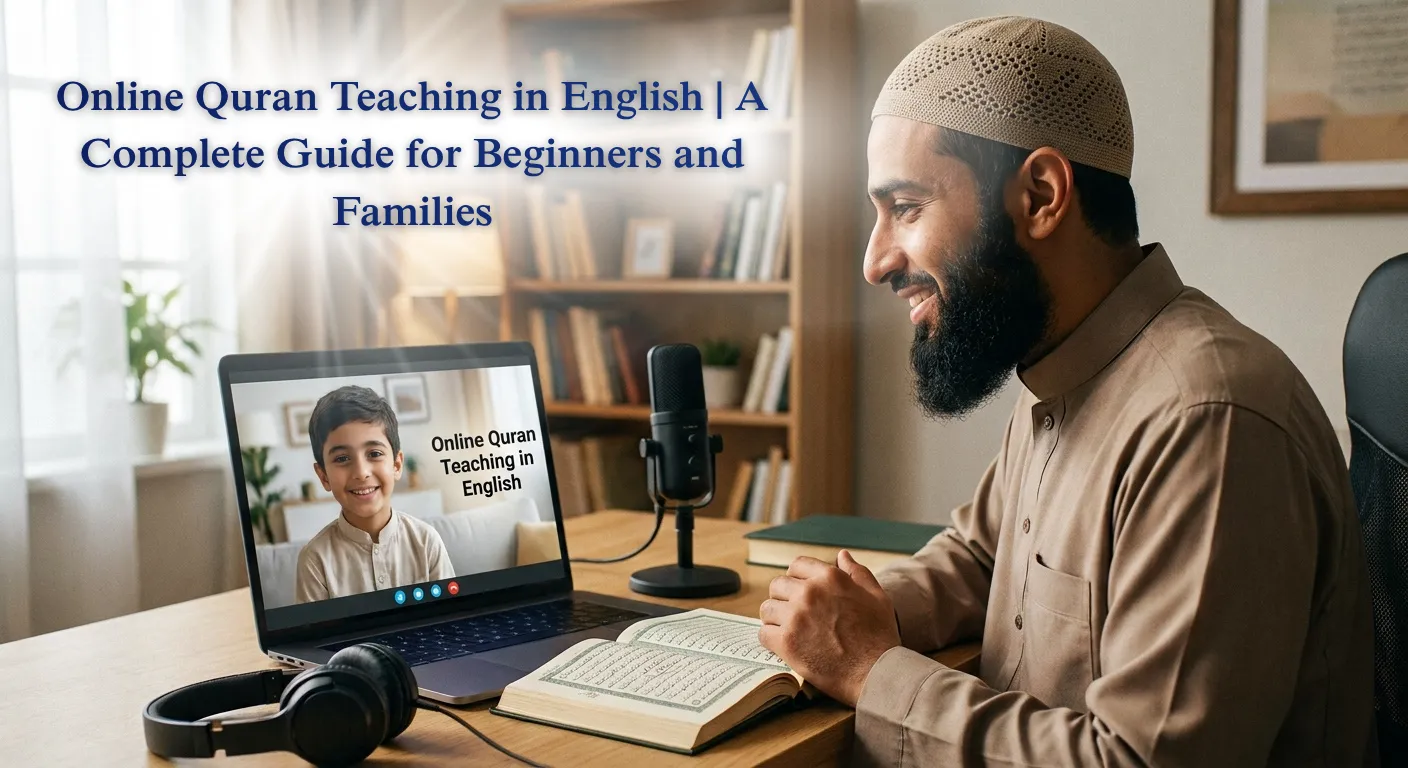
Online Quran teaching in English means learning Quran reading and recitation with a teacher who uses English to explain lessons, demonstrate pronunciation, answer questions, and correct mistakes. Students attend live classes using a phone, tablet, or computer. During each lesson, the teacher listens to their recitation and helps them improve. The main difference is the language of instruction. For example, an Arabic-speaking teacher might explain the pronunciation of the letter ع using Arabic terminology. An English-speaking Quran teacher can demonstrate the same sound and explain how the throat produces it using words the student understands.
This makes lessons more accessible without changing the Arabic text of the Quran.
Do You Need to Speak Arabic to Learn the Quran?
No. You can begin learning Quran reading without speaking or understanding conversational Arabic. Reading Quranic Arabic and speaking Arabic are related but different skills. A beginner can learn to recognize Arabic letters, understand vowel marks, and pronounce Quranic words before developing broader Arabic language skills. However, understanding the meaning of what you recite is valuable too. Students who want to explore Quranic vocabulary and meanings can gradually add Arabic language studies to their learning journey.
Important: English explanations help students understand the lesson, but English transliteration cannot fully represent every Arabic sound. Learning to recognize and read Arabic directly should remain an important goal.
Why Is Online Quran Teaching in English Helpful for Non-Arabic Speakers?
For many learners, the greatest challenge is not motivation. It is understanding how to produce unfamiliar Arabic sounds and knowing what to do when something goes wrong.
English-language instruction helps address these difficulties.
1. Clear Explanations of Difficult Arabic Sounds
Some Arabic letters have no direct equivalent in English.
Consider these examples:
| Arabic letter | Common difficulty | How a teacher can help |
|---|---|---|
| ح (Ha) | Confusing it with the English H | Demonstrating the breathy throat sound |
| ع (Ayn) | Finding the correct articulation | Explaining and practicing the throat movement |
| ق (Qaf) | Pronouncing it like ك | Demonstrating the deeper articulation |
| ص (Sad) | Confusing it with س | Teaching the difference between emphatic and non-emphatic sounds |
A teacher can describe these differences in English, demonstrate each letter, and listen as you practice.
That last step matters. Reading an explanation does not always reveal whether you produce the sound correctly.
2. More Confidence When Asking Questions
Students sometimes feel uncomfortable interrupting a lesson, especially when they struggle to understand the teacher’s language.
With English explanations, they can ask questions such as:
- Why does this letter sound different here?
- How long should I stretch this vowel?
- Where should my tongue touch when pronouncing this letter?
- Can we repeat this verse before moving forward?
Clear communication makes it easier to understand corrections and participate actively.
3. Personalized Lessons Instead of a Fixed Learning Pace
Every student begins at a different level. One learner might already read Arabic but struggle with Tajweed. Another may need several lessons to distinguish similar letters. In one-to-one online Quran classes, teachers can adjust their explanations and practice exercises to match individual needs. A student can spend additional time mastering a difficult sound without worrying about keeping up with a group.
4. Flexible Learning for Busy Families
Online lessons eliminate the need to travel to a physical classroom. Parents can arrange classes around school activities, while adults can choose schedules that fit their work and family responsibilities.
At Muslim Academy, students can explore one-to-one Quran lessons with qualified teachers, flexible scheduling, and individual progress tracking.
What Will You Learn in Online Quran Classes in English?
The learning journey depends on your current ability and goals. A complete beginner needs a different starting point from someone who already reads the Quran and wants to refine their recitation.
Here is a practical overview.
| Learning level | Main focus | Expected learning direction |
|---|---|---|
| Complete beginner | Arabic letters and basic sounds | Recognize and pronounce letters |
| Foundation | Vowels and connected letters | Read simple Arabic words |
| Developing reader | Quranic words and short verses | Read with greater accuracy |
| Tajweed learner | Articulation and recitation rules | Apply Tajweed during recitation |
| Memorization student | Hifz and structured revision | Memorize and retain selected passages |
Students may move between these stages at different speeds. A good teacher checks actual reading ability rather than advancing students according to a rigid timetable.
Learning Arabic Letters with Noorani Qaida
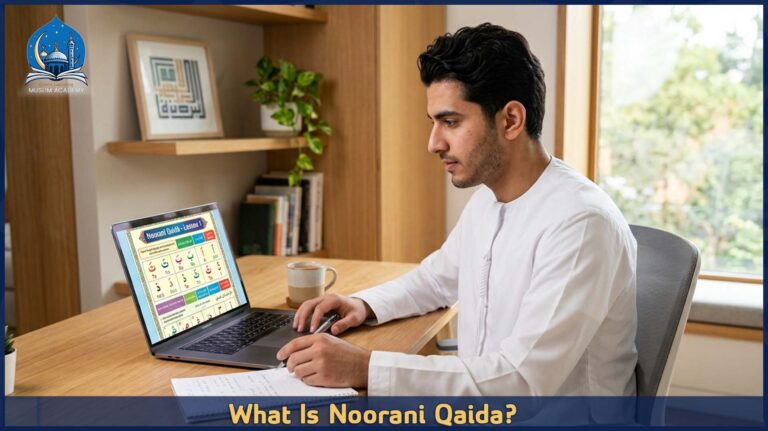
Many beginners start with Noorani Qaida, a structured method for developing Arabic reading skills.
Lessons introduce individual letters, their shapes, and their pronunciation before moving toward connected words.
Students also learn essential reading marks:
- Fatha: The short /a/ vowel.
- Kasra: The short /i/ vowel.
- Damma: The short /u/ vowel.
- Sukoon: A mark indicating the absence of a vowel.
- Shaddah: A mark showing consonant doubling.
Learning these foundations helps students recognize words instead of relying entirely on memorized sounds.
You can explore Muslim Academy’s Noorani Qaida Course or read the detailed article What Is Noorani Qaida? to understand this learning method.
Moving from Arabic Words to Quran Recitation
Once students recognize letters and vowels, they begin reading connected words and short Quranic passages. At first, they may read slowly and pause frequently. That is normal. The teacher helps students combine sounds, recognize common patterns, and correct errors before those errors become habits. Gradually, students can develop more natural reading fluency while maintaining attention to pronunciation.
Learning Tajweed Through English Explanations
Tajweed involves giving Arabic letters their correct pronunciation and applying the recitation rules that govern them.
Teachers introduce concepts gradually, including:
- Makharij: The articulation points of Arabic letters.
- Sifaat: The characteristics that distinguish letter sounds.
- Madd: Rules governing vowel elongation.
- Ghunnah: Nasalization in specific recitation contexts.
- Qalqalah: The controlled echoing quality of certain letters.
- Noon Sakinah and Tanween: Rules that affect pronunciation according to the following letter.
Students should practice these concepts through actual recitation rather than only memorizing their definitions.
The Quran emphasizes measured recitation in Surah Al-Muzzammil 73:4.
For focused guidance, Muslim Academy offers an Online Tajweed Course for learners who already have basic Quran reading ability.
How Do English-Speaking Quran Teachers Teach Online?
An effective Quran lesson should involve more than listening to the teacher speak.
Students need opportunities to hear Arabic sounds, reproduce them, identify mistakes, and practice corrections.
Step 1: Understand the Student’s Current Level
A teacher begins by asking about the student’s experience.
Can the student recognize Arabic letters? Can they read short words? Have they previously studied Tajweed?
For someone who already reads, the teacher may request a short recitation to identify pronunciation difficulties.
Step 2: Explain and Demonstrate
The teacher introduces a manageable skill, explains it in English, and demonstrates the correct sound.
For example, when teaching Qalqalah, the teacher may first explain which letters have this characteristic and then demonstrate it in selected words.
Step 3: Listen and Correct
The student repeats the sound or verse aloud.
The teacher listens carefully, identifies specific mistakes, and explains how to correct them.
A useful correction includes both what went wrong and what the student should change.
Step 4: Practice in Context
Students move from isolated sounds to complete words and Quranic verses.
This helps them apply their learning during actual recitation.
Step 5: Review Previous Lessons
Regular revision helps teachers identify recurring mistakes and determine whether students are ready for new material.
Teaching Insight: A useful Quran lesson gives students plenty of time to recite aloud. Understanding a rule is important, but applying it accurately is the real goal.
Online Quran Teaching in English for Kids
Children growing up in English-speaking households may understand everyday English far better than Arabic.
For these learners, English-based instruction can make Quran classes feel more familiar and less intimidating.
However, teaching children requires more than choosing the right language.
How Can Teachers Keep Children Engaged?
Young learners often benefit from short explanations, clear routines, and frequent opportunities to participate.
Depending on the child’s age, a teacher might use visual letter recognition, repetition exercises, simple learning activities, and positive feedback.
Instead of presenting several new rules at once, the teacher can introduce one skill and help the child practice it successfully.
What Should Parents Look for?
When choosing online Quran classes for kids, parents should consider the teacher’s experience with children, communication style, and ability to maintain attention.
A supportive learning environment should encourage children to try again when they make mistakes.
Parents can also help by providing a quiet learning space, monitoring early lessons, and encouraging short practice sessions.
Muslim Academy’s Quran for Kids program includes personalized Quran reading, Tajweed, and memorization lessons designed around children’s abilities.
Parent Tip: Ask your child to explain one thing they learned after each class. This simple conversation can reveal whether they understood the lesson without turning revision into a stressful test.
Online Quran Classes in English for Adults and New Muslims
Learning the Quran is not limited to childhood.
Many adults begin studying Arabic reading later in life, while others return after years without regular recitation practice.
New Muslims may also want to learn essential surahs for daily prayer.
An English-speaking teacher can explain unfamiliar concepts without assuming the student already understands Arabic terminology.
Starting Without Previous Experience
Adult beginners can begin with Arabic letters, pronunciation, and simple reading exercises.
There is no need to rush toward advanced Tajweed before building basic reading skills.
Improving Existing Quran Recitation
Adults who already read the Quran may benefit from lessons focused on specific mistakes.
For example, a teacher might identify repeated errors in Makharij or vowel length and create targeted practice exercises.
Balancing Quran Learning with Daily Responsibilities
Adults often manage work, family responsibilities, and other commitments.
A manageable schedule with regular revision is usually more sustainable than an intensive routine that becomes difficult to maintain.
The best learning plan is one you can follow consistently.
How to Choose the Right Online Quran Teacher in English
Not every teacher who speaks English can explain Quranic pronunciation effectively.
The right instructor needs both subject knowledge and the ability to teach.
Before enrolling, consider these factors.
Quran Knowledge and Teaching Qualifications
Ask about the teacher’s education, Quran recitation training, Tajweed background, and experience teaching non-Arabic speakers.
An Ijazah may demonstrate authorization in a particular recitation tradition, but it should not replace evaluating the teacher’s practical teaching skills.
Clear English Communication
A teacher should explain unfamiliar concepts using simple language and understandable examples.
You should feel comfortable asking for clarification or requesting additional practice.
Experience with Your Learning Level
Teaching a five-year-old beginner differs from helping an adult improve advanced recitation.
Look for someone who understands your goals and can adjust their methods accordingly.
Constructive Pronunciation Feedback
During a trial lesson, notice whether the teacher identifies specific mistakes and explains how to improve.
Generic encouragement alone is not enough.
A Structured Learning Plan
Ask how the teacher organizes lessons, reviews progress, and decides when students are ready to advance.
For a more detailed teacher-selection checklist, read How to Find the Best Quran Teacher Online for You or Your Child.
What Does a Good Online Quran Lesson Look Like?
A well-organized lesson balances review, new learning, and active practice.
For illustration, a 30-minute beginner lesson might look like this:
| Lesson stage | Example duration | Activity |
|---|---|---|
| Warm-up | 5 minutes | Review earlier sounds |
| New learning | 8 minutes | Explain and demonstrate a skill |
| Guided practice | 12 minutes | Student recites and receives corrections |
| Wrap-up | 5 minutes | Review mistakes and assign practice |
This is an example, not a universal teaching schedule. Beginners may need more repetition, while intermediate students may spend most of the lesson reciting.
Questions to Ask During a Trial Class
Before choosing a program, consider asking:
- Will the teacher explain lessons in English?
- How will you assess my current Quran reading level?
- How much of each lesson will involve active recitation?
- Will I receive individual pronunciation corrections?
- How will you track my progress?
- What should I practice between classes?
- Can the lesson schedule accommodate my availability?
A trial lesson should help you understand the teacher’s methods, not simply introduce the course.
How to Practice Quran Reading Between Online Lessons
Attending classes provides guidance, but independent practice helps students remember what they learn.
A simple routine can make a meaningful difference.
A Practical Weekly Study Plan
| Day | Practice activity |
|---|---|
| Monday | Attend a live Quran lesson |
| Tuesday | Review corrected letters and words |
| Wednesday | Listen to a reliable Quran recitation and practice |
| Thursday | Attend another live lesson |
| Friday | Review recently learned Tajweed rules |
| Saturday | Read a short passage independently |
| Sunday | Revise difficult sounds and prepare questions |
Students can adjust this example to their schedules.
Use Reliable Listening Resources
Listening to accurate recitation helps students recognize Arabic sounds and reading patterns.
Quran.com provides Quran text, audio recitations, translations, and other learning resources.
Try listening to a short passage, repeating it carefully, and reviewing difficult words with your teacher.
Listening supports learning, but it cannot replace personalized correction.
Keep a Pronunciation Notebook
Write down the sounds, words, or Tajweed rules you find difficult.
For example:
- Letter: ع
- Difficulty: Producing the correct throat sound.
- Teacher’s correction: Focus on the articulation without adding an extra vowel.
- Practice goal: Repeat the sound and review it in selected Quranic words.
This approach helps make practice more specific and productive.
Common Challenges English-Speaking Quran Learners Face
Even with a qualified teacher, some challenges take time to overcome.
Relying Too Much on English Transliteration
Transliteration can provide temporary support, but it often hides important differences between Arabic sounds.
Students should gradually rely more on Arabic letters and direct listening.
Trying to Learn Too Many Rules at Once
Tajweed includes many concepts, but beginners do not need to master everything immediately.
Focus on accurate pronunciation and foundational reading before advancing toward more detailed rules.
Skipping Revision
Students may understand a lesson during class and forget parts of it several days later.
Short, consistent revision can help reinforce learning and reveal areas that still need attention.
Comparing Progress with Other Students
Every learner has a different starting point.
Previous Arabic exposure, lesson frequency, age, and practice habits can influence progress.
Focus on what you can read more accurately today compared with your earlier lessons.
Remember: Making mistakes during Quran learning is part of developing a new skill. A patient teacher should help you understand and correct them without making you afraid to recite.
Why Learn Quran in English with Muslim Academy?
Choosing an academy involves more than finding a teacher who can conduct lessons online.
Students also need clear learning goals, consistent instruction, and a program that matches their abilities.
Muslim Academy offers personalized online Quran education for children and adults.
Its published learning options include:
- One-to-one lessons: Individual instruction based on each student’s needs.
- Qualified teachers: Quran educators with backgrounds in Quran, Arabic, and Islamic studies.
- Flexible schedules: Lesson times arranged around student availability.
- Progress tracking: Guidance that helps students identify their achievements and areas for improvement.
- Free trial classes: An opportunity to experience the teaching approach before enrolling.
Students can explore the available Quran and Arabic courses and choose a suitable starting point.
Complete beginners may begin with Noorani Qaida, while students with existing reading skills can focus on Tajweed or structured memorization.
Teacher matching and preferred lesson arrangements should be discussed during the initial consultation.
Frequently Asked Questions About Online Quran Teaching in English
Can I learn the Quran online entirely in English?
Teachers can explain lessons and communicate in English, but students learn Quran reading and recitation in Arabic. English supports understanding; it does not replace the original Quranic text.
Are online Quran lessons in English suitable for complete beginners?
Yes. Complete beginners can start with Arabic letters, vowel marks, pronunciation, and simple words before progressing to Quranic verses.
Can children learn Quran with English-speaking teachers?
Yes. Children can benefit from English-language explanations, especially when English is their main spoken language. Age-appropriate activities and patient instruction are important.
Can I learn Tajweed without understanding Arabic?
Yes. You can learn Arabic pronunciation and Tajweed rules through English explanations. Basic Quran reading ability is helpful before joining a dedicated Tajweed course.
How many online Quran classes should I take weekly?
The appropriate frequency depends on your goals, availability, and learning level. Some students begin with one or two lessons weekly, supported by regular independent practice.
How long does it take to read the Quran fluently?
There is no universal timeline. Students progress differently depending on their starting skills, lesson consistency, pronunciation difficulties, and practice habits.
Can I request a female Quran teacher?
Some academies offer this option. Muslim Academy allows students to request a female teacher, subject to availability and suitable scheduling.
What equipment do I need for online Quran lessons?
You generally need a phone, tablet, or computer, a stable internet connection, a working microphone, and a quiet space. A camera may improve interaction.
Is learning Quran online as effective as attending classes in person?
Both formats can support effective learning. Online lessons work best when students receive live recitation correction, regular teacher interaction, and consistent opportunities to practice.
Start Your Quran Learning Journey with Confidence
Learning the Quran becomes more approachable when the instructions are clear, the teacher understands your needs, and every lesson builds on your previous progress.
Online Quran teaching in English helps children, adults, and non-Arabic speakers learn essential Quran reading skills without needing to understand spoken Arabic before starting.
Whether your goal is to recognize Arabic letters, improve Tajweed, or recite with greater confidence, consistent practice and qualified guidance can help you move forward.
At Muslim Academy, you can begin with a free trial class, discuss your learning goals, and explore a personalized study plan suited to your level.
Book Your Free Quran Trial Class at Muslim Academy and take the next step toward clearer, more confident Quran recitation.